Saturday, February 16, 2008

Montessori Beginnings


This is my man on the road attempts at academic greatness....some of the lines don't make sense to me at all after I handed in my assignment. Oh well, I'm trying to learn.....

  1. What is the distinction between a methodology and a philosophy of education?

Philosophy means the love of wisdom. John Dewey went a step further in defining philosophy of education as the process of forming fundamental disposition, intellectual and emotional, toward nature and fellow-men, philosophy may even be defined as the general theory of education. Unless a philosophy is to remain symbolic—or verbal-or a sentimental indulgence for a few, or else mere arbitrary dogma, its auditing of past experience and its program of values must take effect in conduct (MW 9: p. 338).

A less radical approach would be that the philosophy of education is the study of the purpose, process, nature and ideals of education. This can be within the context of education as a societal institution or more broadly as the process of human existential growth, i.e. how it is that our understanding of the world is continually transformed via physical, emotional, cognitive and transcendental experiences.It can naturally be considered a branch of both philosophy and education.

( http://en.wikipedia.org/wiki/Philosophy_of_education )

Methodology of education can be defined as a set or system of methods, principles, and rules for regulating a branch of pedagogics dealing with analysis and evaluation of subjects to be taught and of the methods of teaching them.

( http://dictionary.reference.com/search?q=methodology )

The methodology of education can be taken as a subset of the philosophy of education which is concerned with the principles and procedures of inquiry in gaining knowledge. Henceforth, the philosophy of education is the basis of the system which is the method.

When one carries out a method, it must thus be guided by the philosophy as in the case of the Montessori method which is for example, is always guided by the philosophy of following the child. We can make the child work on a didactic material but to have insisted that the child do a particular exercise would have gone against the philosophy of following the child and thus be in conflict too with the method of presenting the material when the child is ready to do so, for example.

  1. Would you describe Montessori's philosophy of education as being metaphysical or existential? Explain your opinion.

The teacher must derive not only the capacity, but the desire, to observe natural phenomena. The teacher must understand and feel her position of observer: the activity must lie in the phenomenon. (The Montessori Method, ch. 5 )

Montessori's method can only be described as existential as they are based on her observations of the children. It does not seek only to explore ideas of what a child is but is based on pursuing personal meaning in existence because education is a natural process carried out by the human individual, and is acquired not by listening to words, but by experiences in the environment.” ( Education in a New World )

From the beginning, even in her work with the less able students, Montessori had made extensive observations from which she would produce the didactic materials and the learning environment. Her 'method' thus came about as a response to what she has observed of the child and not purely from a theory that seeks to be applied to the child.

By observing the child, a teacher would know how and what is best to be presented to the child to capture the spark that would lead him to pursue knowledge because we are here to offer to this life, which came into the world by itself, the means necessary for its development, and having done that we must await this development with respect.

Perhaps the strongest sense that we get that Montessori's philosophy is existential can be seen in her words that "There was no method to be seen, what was seen was a child...acting according to its own nature." ( Secret of Childhood, p.136 )

  1. What is the role of a child's intentionality in Montessori's understanding of education?

Intention begins to exist in a child when he is able to act out of his own accord. It is not something that suddenly exist in a child but needs to be developed in accordance with the laws of nature.

In the beginning, the child acts more out of instinct. To awaken his will, the child needs to go through a slow process that evolves through a continuous activity in relationship with the environment. The consciousness of choice needs to be constantly used and practiced before it can be fully developed.

The process however, can be a painfully long one if the educator tries to bend the will of the child to her own, seeing it as an expression of rebellion. Here, Montessori links the will or intentionality of the child with obedience. She believes that a child is not able to comply to instructions when she has not mastered the skills needed to do so.

Instead, the educator must realise that the child goes through three stages of obedience where at first it is dictated purely by the hormic impulse, then it rises to the level of consc, and thereafter it goes on developing, stage by stage, till it comes under the control of the conscious will.

He begins by being able to obey at times and moves on to the second stage where he is more able in his actions and can act according to not only his will but that of another. At the third stage, he obeys not only because he wants to but because he is in awe of the person who instructs him.

  1. What influences did the anthropologist, Sergi, and the French physicians, Itard and Sequin, have on Montessori's way of educating children?

Sergi's most significant influence on Montessori was the idea of turning anthropology 'from the classification of abnormalities to the discovery of ways of preventing the abnormality, through the establishment of a scientific pedagogy based on the anthropological study of children' Montessori basically applied his methods of scientific observation to understanding the learning behaviour of children.(Maria Montessori , A Biography p. 71)

These scientific observations are however not the essence of how we should educate the child, according to Sergi, but it shows us the way to do so for we cannot educate anyone until we know him thoroughly '(Ibid, p. 98)

Itard, best known for his work on the Savage of Aveyron, was influential in the area of sensorial education where he set out to educate the mind through sensorial exercises in gradually increasing levels of difficulty. We can see this in Montessori's primary sensorial materials such as the rough and smooth boards and the baric tablets.

Itard's work on the mentally and physically challenged was to be continued by Seguin, his student, who would further develop the methods in educating these children in the belief that their inadequacies can be overcome somewhat by training. This was seen in Montessori's opinion that mental deficiency presented chiefly a pedagogical, rather than mainly a medical , problem ( The Montessori Method p. 31)

Another revolutionary aspect that could later be seen in Montessori's work was Seguin's unique treatment of the child for to him respect for individuality is the first test of a teacher. ( Idiocy & It's treatment by the Physiological Method p. 33)


  1. What influences did Montessori's beginning educational work with idiot and wounded children have on her understanding of the learning process?

Montessori believed that children are the product of the educational system that they were in. When she began to be interested in the deficient children, she believed that they were at the lowly state they were in because there was nothing in the asylums that stimulated their already wounded mind and body.

The success of her methods with them, some of whom learnt to read and write and even passed the national exams, convinced her that even more could be achieved if the same methods were used with the normal children as they contained educational principles more rational than those in use' and ' that similar methods applied to normal children would develop or set free their personality in a marvelous and surprising way. ( The Montessori Method pp.32-33)

Montessori's work with the deficients were the building blocks of her work with the normal children such as the principle of the education of the senses and then the intellect, as seen in the walking exercises to the later programme of learning how to read from raised letters and teaching a skill by having the child repeat an exercise that prepares him for it, as in the practical and sensorial exercises found in Montessori classes that precedes writing.


References

www.montessorilive.net

Education for a New World

Maria Montessori, A Biography, Kramer, Rita

The Absorbent Mind

The Montessori Method

The Secret of Childhood, Montessori, M.,


Saturday, February 02, 2008

my remaining two-thirds for week 3 of my foundations course

Jean Piaget


  1. What is significant in Montessori’s move from mathematics and engineering to the study of the mind and the science of psychology?


There were interesting parallels in the life of Montessori and Piaget. Montessori moved from engineering to a more biological faculty of medicine, while Piaget who was encouraged by his mother to enter the religious order moved to Zoology.


It is for both of them while in the fields of medicine and zoology that they developed an interest in the growth of human: Montessori through the field of embryology and Piaget through his studies of mollusks and clams. While Montessori also got into the field anthropology before moving on to psychology, Piaget's study of mollusks and clams got him interested in psychological analysis and through his readings, began to be interested in human intelligence and how it develops.

While Montessori was given the opportunity to carry out her observations and test her theories through her work first with the mentally handicapped, Piaget had the pleasure of observing his own children.


Their work thus sprang both from the scientific observation of the child and eventually produced their own scientific pedagogies where the child's growth is divided over stages. Montessori developed the Sensitive Periods while Piaget produced the Cognitive Theory of Development. They both believed that in order to develop the child holistically, we must first respect the stage of development the child is in and duly respond to it.


Rudolph Steiner

  1. Based on his deep understanding of the needs of the growing child what basic areas of the human child did Steiner purpose his education to develop?


A Waldorf education should develop in the child a clarity of thought and a balance of feelings that also produces someone who has a strong sense of self and the people around him. Steiner also strove to develop the child's conscience and initiative.

This is done in a school that stresses on the arts as it touches a part of the child in the most intimate sense for 'reverance awakens in the soul a sympathetic power which would otherwise remain concealed.'

There is a higher man in every child that only when he is awakened, will the child be able to attain supersensible knowledge. This knowledge is made clear to the child when he is given the opportunity to contemplate on his past experiences with the ideas from men who are already knowledgeable.

It is however not developed in a vacuum but is to be related to the world around him. In fact, Steiner believes that a child's aim in learning is not for himself but to see how he can be a productive contributor to the good of the earth.

Here we see a similarity to Montessori's cosmic education where the child is aware of his place in life. Being that he sees the reason for his existence in connection to the rest of life, work becomes a source of life to him.' For now he knows that his labor and his suffering are given and endured for the sake of a great, spiritual, cosmic whole. Not weariness, but strength to live springs from meditation.'

This becomes a spiritual motivation for the child to endeavour in his work as he has innate realisation that this work is essential for the inner man in him, or what Steiner called the work-a-day man, to be actualised so that he can perform his cosmic role.


References

www.montessorilive.net

www.comnet.ca

www.uea.ac.uk

www.rsarchive.org


Wednesday, January 30, 2008

Vygotsky

I wish I've read Vygotsky earlier, now he's my other favourite Russian writer, besides Chekov. Then again, if I've read him in secondary school like I did Chekov, there would not have been any love lost, there was nothing in children then that I would have found to be of any interest or relevance to me.

Here's one-third of my second assignment due this Friday ( which is Thursday there, thank God for the time difference).

Lev Vygotsky


  1. Explain Vygotsky's key concepts: Zone of Proximal Development, Scaffolding , Play. How do such relate to educational practice?


Vygotsky defined the zone of proximal development as ' the distance between the actual development level as determined by independent problem solving and the level of potential development as determined through problem solving under adult guidance or in collaboration with more capable peers.'

He gave the example of two children with the standardised mental age of an eight year old. One though can solve problems up to that a 9 year old can do while the other up to the difficulty level of a twelve year old with guidance.

He concluded that they are not of the same mental age after all and that their learning would eventually have to take on a different rate. Whatever the child can already do is learning that has already matured but those functions in their embryonic stage that are still maturing is what Vygotsky called the zone of proximal development.

Educators thus need to identify two levels of the state of a child's development: 'the actual development level and the zone of proximal development'. It is in this zone where the child can achieve his potential with the guidance of an adult or his more capable peers. The ability to cater to this part of a child's development not only ensures that he is not bogged down and turned off by things he has already internalised but allows him to reach a higher level of development.

Scaffolding is ' the gradual withdrawal of adult control and support as a function of children’s increasing mastery of a given task.' based on the ideas of Jerome Bruner. The educator is like the support that gives the children an extra boost as he finds his way to a new stage of learning. However his role is eventually diminished as ' what a child can do with assistance today she will be able to do by herself tomorrow.' ( Vygotsky 1978 p87)

Vygotsky sees the function of the educator in the process of scaffolding more as that of 'a facilitator of cognitive development'. While acting in this role he should be a collaborator in this process who together with the children work towards accomplishing joint goals.

Play creates a zone of proximal development in a child where he is capable of behaving beyond his age. It contains 'all developmental tendencies in a condensed form'. Where two sisters cannot be models of behaviour in real life, when they play sisters they strive to be what they believe is the ideal that is expected from each of them. Though it arises from their imagination, that is initially very close to real life, they subordinate their immediate impulses to the rules of the situation if it was real.

It is thus a strong tool in assisting the child in his development. Opportunities for play should be created in the learning environment to enable this process to take place. Contrary to ensuring that the child is constructively occupied all the time, time off to play can have a very positive effect on the child. Not only does he runs through his experiences, he recreates this in his own controlled environment and characters with real life rules, bridging what he is already capable of and what he can be and eventually becomes capable to function in the role he has played out


References

www.comnet.ca

www.uea.ac.uk

.


Change in angle

I have decided to change this blog from a first person account of homeschooling to be dedicated instead to different educational philosophies or methods especially Montessori, although I'm not so sure now after learning about others but I shall focus still on Montessori where there is an integration of sorts, though that may be because I've only just read on the philosophers who influenced her, and a 'method'.

I'll start by sharing my short write-ups for my Montessori Foundations course that I'm currently taking from www.montessorilive.net. I love the short lectures, the interactive chats and the angle of the whole course. It has made me realise how much 'deeper' the Montessori school of thought is, so unlike the technical concentration on presentation that I'm swamped with in the course I took locally.

Here's my first write-up on the Early Reformers in Education. Do not these are the writings of a layman over a period of a few days and are thus not in depth and not necessarily right: )

Week 1 Assignment: Early Reformers in Education

Jean Jacques Rousseau

  1. What did Rousseau's philosophy of education stress? What did he advise was the role of the educator of the child?

    Rousseau divided education into that which is from nature, man and things. However as

nature is beyond our control and things only partly, we can only take hold of the education of man. All three must work in harmony to produce a well-educated man who will achieve his goal in life and is at peace with himself.

This ideal is however prevented by the norms and demands of life or societal pressures such as that of authority and prejudice. From the start, Rousseau believed that we thwart the true education of children by for example not providing him with the care of his mother and the swaddling the infant that he is unable to fulfill his physical needs.

To overcome this, education should persevere ' to preserve the 'original perfect nature' of the child by means of careful control of his education and environment, based on an analysis of the different physical and physiological stages through which he passed from birth to maturity.' (Stewart and McCann 1967: 28).

Herein, come the role of the educator who is but a facilitator in the whole plan. He must not only be a model to the child but ' prepare his surroundings, so that nothing shall strike his eyes but what is fit for his sight.'

The ideal setting for this scene to Rousseau is the countryside where there is greater control over what the teacher thinks the child should learn and is far removed from the evils of urban life. Apart from providing the right environment, the teacher must also decide on the best education plan for the child which should spring from what the child is inclined to. To find this out, the teacher must ' take time to observe nature; watch your scholar well before you say a word to him; first leave the germ of his character free to show itself, do not constrain him in anything, the better to see him as he truly is.'

John Henry Pestalozzi

    3.What were the elements of the human child that Pestalozzi insisted be in balance for healthy education to take place?

Pestalozzi believed that education should be holistic in that it not only imparts knowledge that already exists but to equip the students in such a way that they become autonomous beings. Central to this process was the need for the 'hand', 'heart' and 'head' to be in equilibrium.

In fact he said, 'the most fearful gift that a fiendish spirit has made to this age is knowledge without power of doing and insight without that power of exertion or of overcoming that makes it possible.'

'Head' was referred to by Pestalozzi as 'man's ability to detach himself through reflection from the world and his confused impressions thereof by developing concepts and ideas.'

In reality however, man's sensitivity is constantly challenged and 'brings him closer to his fellow men in the struggle to control nature through work' (ibid) of what he defines as the heart. Torn between the ideal and reality, man works towards the formation of his own self of what is the 'hand'.

The three elements are however not three separate faculties but one which should be integrated in every educational activity. For example Pestalozzi wrote, ' This A B C of limb exercise must, naturally, be brought into harmony with the A B C of sense exercises, and with all the mechanical practice in thinking, and with exercises in form and number-teaching.'

In his four-step course of the arts, he begins with the correct mastery of a skill and 'at the end of the development there is 'freedom and independence', i.e creative mastery.'


Friedrich Froebel

3.What were the three elements Froebel thought as necessary for the education of the whole child?

Froebel's work was based on three principles; (1) all existence originates in and with God; (2) humans possess an inherent spiritual essence that is the vitalizing life force that causes development; (3) all beings and ideas are interconnected parts of a grand, ordered, and systematic universe. There is an internal spiritual essence- a life force- in every child at birth that seeks to be externalized through self-activity.

'The purpose of education is to encourage and guide man as a conscious, thinking and perceiving being in such a way that he becomes pure and perfect representation of that divine inner law through his own personal choice; education must show him the ways and meanings of attaining that goal.' ( Friedrich Froebel 1826 Die Nenschenerziehung, pp.2)

Froebel shares the Idealist viewpoint that every child has in him from birth all that he is to become. From providing the right environment, the child will then grow into what they were meant to be which was also the basis of the Kindergarten.

We can however only know the inner child from his outer manifestations and he believed that a major part of this is seen in play for 'Play is the highest expression of human development in childhood for it alone is the free expression of what is in a child's soul.'


John Dewey

8. What did Dewey mean by his saying that 'education is life itself'?

'Education is a social process; education is growth; education is not a preparation for life but is life itself.'

In order for life to continue there needs to be a continued process of self-renewal that ensures the survival of the being. As for social life, this role is taken up by education which Dewey sees as the means through which this can be realised.

Education does this through the process of transmitting the 'ideals, hopes, expectations, stantdards, opinions, from those members of society who are passing out' to the young.' If this is not carried out it could mean the demise of the social life of that community.

Life itself too is education for the process of living together ' enlarges and enlightens experience; it stimulates and enriches imagination; it creates responsibility for accuracy and vividness of statement and thought.

This is translated in practice where students would be involved in real-life lessons and challenges such as learning math in cooking and simulations of historical events. This closed the gap between real life and abstract learning from textbooks as information and society progressed at a fast speed.

References

Rousseau, J. J(2004). The Project Gutenberg Ebook of Emile. #5427,

UNESCO (1994) Prospects: the quarterly review of comparative education, vol XXIV, no. ½,,p.297-310).

Pestalozzi, J.H (1894), How Gertrude Teaches Her Children, http://core.roehampton.ac.uk/digital/froarc/peshow/index.htm

www.heinrich-pestalozzi.de/en/documentation/fundamental_ideas/education

Dewey, J. (1997).The Project Gutenberg Ebook of Democracy and Education.#852


Wednesday, July 18, 2007

A rainy homeschooling day


I started school early today by doing my written English and Maths workbooks that I'm supposed to do a page of each day. As mum slept in late, we got to play the trains and cars after that. She got caught up with cutting up some cards, so we managed to slot in time to play with the flashlight.....


Thereafter, we played snap with the Scooby Doo matching cards that mum just made. We were supposed to play naming the cards afterwards but Umayr wasn't interested. I got to play the geography game Seterra with mum. We did Asian countries and flags.


When mum had to read to Umayr, she let me continue playing with the programme, I love playing flags and try very hard to be top of the league. After reading to Umayr, they played speling the animals with the small movable alphabets. He later played matching animals and their young cards.


When I was done with my game, Mum did a worksheet on 'Where I live', we explored where I lived from planets to continent, to country, to city, to address. We didn't have outdoors as it was raining heavily outside.


So, Ummi gave us tissue boxes and cardboard to make train carriages which we decorated with glitter, markers and finger prints. After that, we managed to sneak in some time to play with our trains when ummi was teaching Sofiyya.


As she was cooking, Ummi let us watch the story of Prophet Yusof and Ibrahim online. After lunch, it was time for solat and tilawati. As we had some time after doing our Arabic writing, mum played a game of chess and then it was time for TV......

Wednesday, June 20, 2007

Keeping Abi close....


We were supposed to learn about the United States while Abi is away there for a fortnight but last week both Umayr and I were down with fever for almost the whole week. Last night, we got our first lesson, well I got mine, when Ummi played the 'Alphabet States' with me.


Both of us had a map of the United States. One of us would say a letter and try to name as many states starting with that letter as we can. I had fun but I wonder why Alaska is so far away from the rest of the states and why they made a new Mexico when there's one nearby.


Today, Ummi printed out dollar notes for us with a picture of George Washington on the front. She tried to teach me about pennies, nickels and dimes but I only got the quarters. Anyway, Umayr and I played buying and selling with our foreign currency.


Ummi played another game on the 50 states with me today.The challenge was to name as many states as we can with the help of the map we had last night. Ummi only got 3. I obviously won but 50's a lot of names. I got tired and maybe I'll continue naming the states on the blank map tomorrow.


I tried to read my dictionary after lights out tonight, but Ummi found me out. I wonder what the fuss is about spoiling my eyesight. Now, I don't even know where I stopped....Oh well...

Today, Abi flew to Washington from San Diego. He said it's nicer there with mountains and lots of greeneries. I wish I could be with him....but he'll be back soon. I can't wait to play with my Thomas train set.


Sunday, January 14, 2007

our first plane trip

The day that we have been waiting for has finally arrived;our first trip abroad via plane to Brunei. We woke up before six and were off half-an-hour later to the airport.

After checking in at 7 a.m. ,we had breakfast at the lounge before the long wait at our gate to board the plane. I managed to grab the seat by the window while Umayr sat beside me.

We were supposed to take a Singapore Airlines plane, but it turned out to be a smaller Silkair one instead. Oh well, it was still huge enough for me. The best part was breakfast of course, yummies galore!

I loved watching the things below us getting smaller and smaller....then came the clouds but my ears were a bit clogged, Abi started to get irritated with me for talking so loudly: )

Sofiyya fell asleep halfway through the flight to much of Ummi's relief. Sometimes the plane was a bit shaky but Umayr and me were just excited at being in a plane, we didn't really care.

The flight was over in less than two hours our plane landed at Brunei with a bump!Then we were off to meet our uncle, auntie and cousins whom we have not seen for two years.

Sunday, December 17, 2006

A trip to the zoo and Amozozo


We had a very long day last Tuesday. Ummi took us to the zoo to play at the wading pool with our friends from the homeschooling group. It was fun walking in the pool and trying to catch tadpoles and fish. Christian and his cousin who joined us that day had the biggest haul.


After two hours, wow we didn't even realise it was that long, it was time for lunch and we headed home as Ummi thinks we are already very tired and should take our naps.Umayr did but I continued playing with my toys till Ummi told us that she's taking us to a special place at the National Museum, wherever that is. She decided to take us anyway, though she was very tired, as it was the last day of the exhibition.

So of we went, on a very long taxi ride.


The exhibition was called Amozozo by Architects of air from the UK. Apparently, the huge balloon structure was influenced by Islamic architecture as apparent in the domes, in red, green and blue and the segments in the structure which played on light and colour.


There's Umayr, sitting in one of the segments.After the exhibition, we went to Raffles City where we were joined by Abi for dinner.

Thursday, December 07, 2006

Ummi had lots of ideas for activities today, she was up since morning on what we can do.First counting and adding with coins, then making flowers with circles, learning how to use a needle and sewing through the flowers, playground, shapes in Malay, tv, lunch....

However, soon after lunch, she was knocked out; especially after Sofiyya asked for her milk....hehehe...so I got to play with my trucks and cars without any disturbance as Umayr was also asleep.

When Ummi woke up however, I had to read my tilawati book and recite my surahs. I did something very bad to upset Ummi, so she was very strict with me through the sessions.

After that I did additions with the small number rods and a worksheet that Ummi printed out for me. I only got to the addends of 8, actually I was too bored and tired by then and eager to join Umayr and Sofiyya who were finger painting in the kitchen.

When we finished our finger painting, Ummi let us play in the pool in the bathroom.That was fun... I always love playing with water.While we played, Ummi scrubbed some dirty mats and looked after Sofiyya who joined us in the pool.

Then, I got to play games from the Sesame Street website. I was supposed to have that yesterday but as we went to Labrador park, Ummi let me play today.

I made Ummi upset again and she was very angry. After giving me a earful, we went to Lot 1 to collect some books that Ummi reserved.We had a very nice dinner of spaghetti and fish and chips with mango juice...After window shopping for a while, it was time to go home and sleep.

Hope, Ummi's more tired tomorrow...then I'll get to play with my cars more....

Wednesday, November 08, 2006


I'm not well today so ummi and abi took me, together with Sofiyya and Umayr to our doctor at Bukit Gombak, have the cold and a slight fever. We had brunch at Alif, my favourite prata shop and then went back without Abi as he had to go to work.

When we got home, ummi gave me my medicine, five in all. Later ummi showed us how we can get different colours from just three basic colours of red, yellow and blue. They are called primary colours.

She put them in these transparent plastic cups so we could see how the colours change. After that, ummi let us, including Sofiyya, paint with the different colours that we made. We even had a spray to paint with. Sofiyya truly enjoyed herself as this is her first painting session.

Ummi then let us play in the pool. We played 'rain' with the colander and our elephant water container. She also gave us funnels to pour water into our water wheel. After all that action, we had TV time, we watched Sesame Street and The Backyardigans. Then, its off to bed....zzzzzz....so tired.

Friday, November 03, 2006

a walk in the park


Yesterday we had a nice walk in Choa Chu Kang Park with Ummi and Sofiyya. At first we wanted to play at the sandpit playground but we decided to join Sofiyya at the toddler's playground instead.

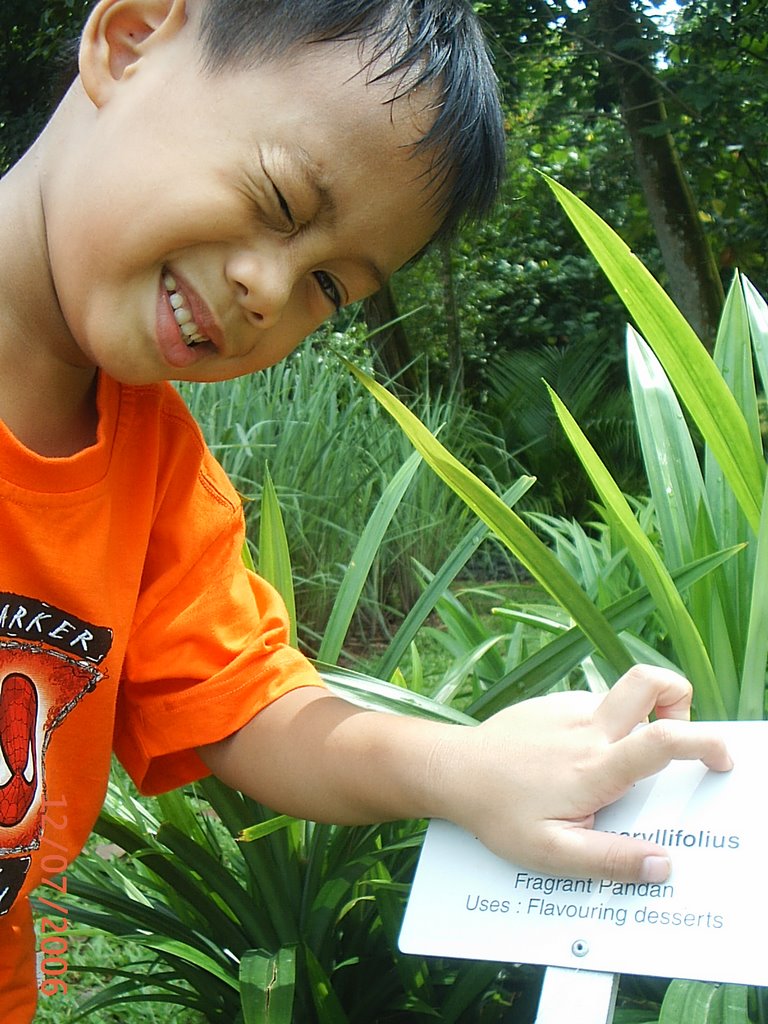
After a while, Ummi called us to take a walk to look at the different plants that can be found there. She let us take photos of the Cempaka Hutan, lime, curry and lemongrass plants. Unfortunately, we were unable to take any home as souveniors, maybe next time we can plant some at home. After learning about the plants, we sat down for a drink and Ummi asked us to look at the different shapes of the plants around us. Some were triangular, some round and some looked like fans.


We then took a slow walk to Lot 1, stopping to look at the mimosas in the open field for a while before having our lunch there.We really enjoyed ourselves that by the time we got home we were too tired for anything else, much to Ummi's relief.

Monday, October 30, 2006


A week ago, a day before Hari Raya, Ummi let us in on the action that was abuzz in the house. We got to scrub clean our table and chairs, we've never seen Ummi wipe it that clean like we had.

Ummi sprayed the water, then, the cleaning fluid, she didn't let us spray coz she was worried that we'd hurt ourselves. She said there were chemicals in it that is dangerous to us. Adults; they get to do all the fun stuff.

We had fun scrubbing all round the table, sometimes Ummi will point out to us the parts we missed.After the table, we got to scrub the chairs. Thereafter, we wiped it with the kitchen towel and when all was dry we put them all nicely in our room.

Can't wait for the next spring cleaning. Then again, Ummi always make us clean up.Her most common quotes are "Never take another toy before you keep the one before", " If you spill; wipe." and "What are all these toys doing on the floor?!"

Thursday, October 26, 2006


Assalaamualaikum wr wb

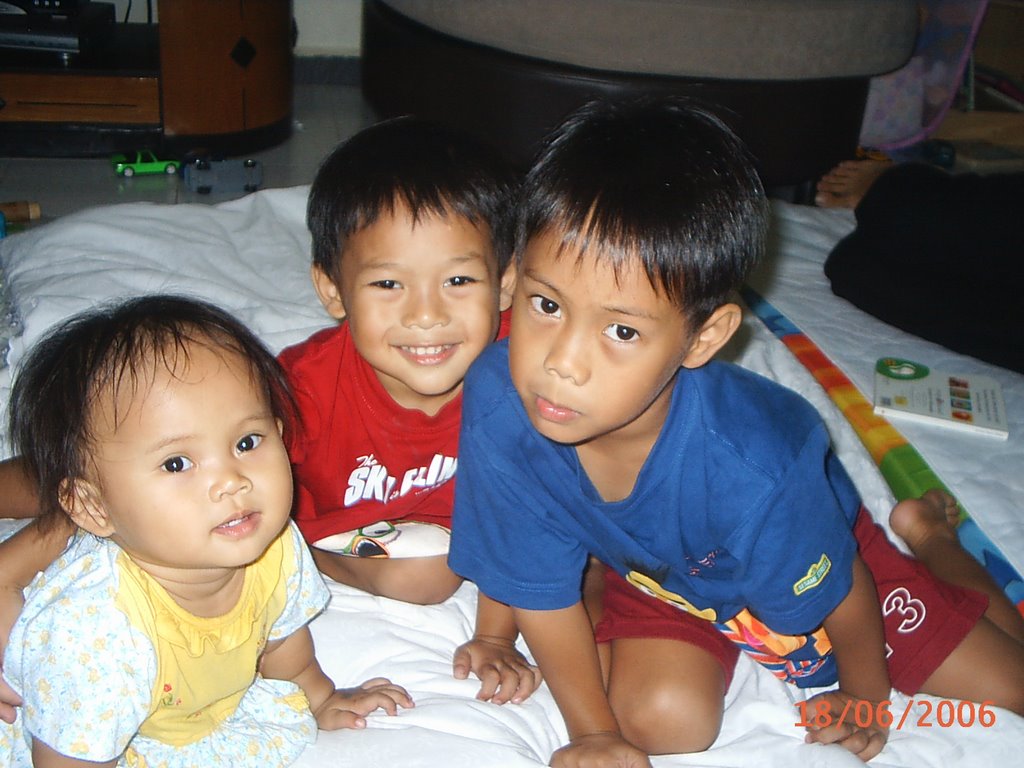
Hi! We are brothers Ihsan and Umayr on a journey of adventure and discovery.Come join us, together with our mummy and baby sister, Sofiyya, as we learn about the wonderful universe of knowledge.You can also read about Sofiyya at www.sofiyya.blogspot.com.